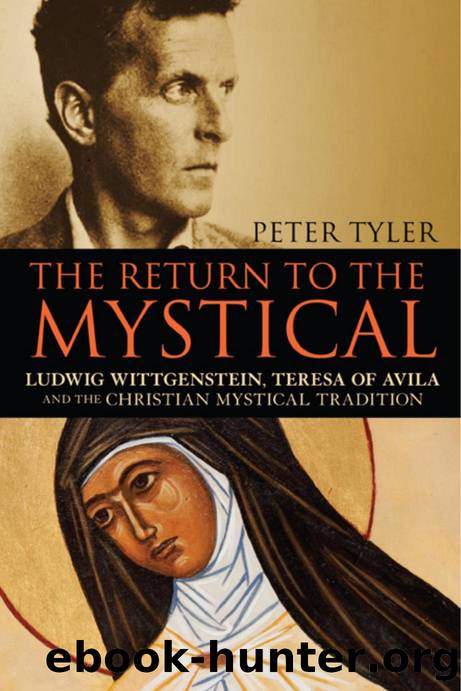
The Return to the Mystical: Ludwig Wittgenstein, Teresa of Avila and the Christian Mystical Tradition by Peter Tyler
Author:Peter Tyler
Language: eng
Format: mobi
Tags: Religion, Christian Theology, General
ISBN: 1441104445
Publisher: A&C Black
Published: 2011-06-15T23:00:00+00:00
The Emergence of the Spanish School
127
unite them in an instant with God⦠we become suddenly recollected and the wonderings of our incautious thoughts are dispersed.â
As with de Osuna, and later with Teresa, Laredo does not describe the divine life but points towards it through implication and the preparation of the capacity of the self. The divine life will, as with Wittgenstein, âmake itself manifestâ, for it cannot be described within the mystical theology. For Laredo it is not an intellectual knowing but
âa knowledge and understanding from experienceâ (AM:15): So sublime is this science (mystical theology) that though this or that servant of His can speak of it, as it were stammeringly, only His boundless Majesty can cause it to be understood inwardly, make it to be felt within the soul and implant it into the heart.
(AM:15)
In common with the tradition there is the emphasis on the âdivine unknowingâ that began life with Dionysius:
In the secrecy of this wisdom, the soul knows that it is united with the Divine fellowship, through Divine condescension through a bond of love; yet, notwithstanding, its knowledge is such that it understands not how it understands that which it understands. It knows it without knowing how it knows it; it knows that it has a knowledge of God but, because He Whom it knows is incomprehensible, it knows not how to know through understanding.
(AM:11)
As we have seen so many times already, this âdivine unknowingâ is linked to the affect which for Laredo is the âupsurging powerâ that brings us to God. The surge of love that leads us to God is described in the same direct fashion as Balma so that, unlike de Osuna who relies more heavily on the subtle distinctions of Gerson, we have in Laredo something closer to the strong upsurge described by the early Victorines.
The âmystical theologyâ is thus for Laredo the vÃa de aspiración or the
128
The Return to the Mystical
âway of aspirationâ (AM:11). Where Laredo differs from Osuna is in the emphasis on the strength of this passion. At every point in the Ascent of Mount Sion (as with Balmaâs Viae Lugent Sion) the âupsurge of the affectâ threatens to overwhelm the self. Laredo memorably describes it thus:
The heart, by which is here to be understood the fire of love, must be alive in every contemplativeâs soul, must of a sudden pour itself wholly forth into infinite love, like a jug full of water when it is turned to face downwards.
(AM:27)
Laredo calls this element of the mystical strategy the âamative powerâ
or âloving abilityâ ( amativa virtud) which he defines as âthe eager will that attains quiet in loveâ: âla muy pronta voluntad, que está quietada en amorâ (AM:29). Thus, he says, his writings will âexcite our affective natureâ so that we too may experience the âgentle sweetnessâ of the divine, âmelting those that have no warmthâ.
The
Ascent concludes in a somewhat scrappy fashion. No doubt Professor Allison Peers would not approve. Yet in line with the view that what Laredo is presenting is mystical theology rather than speculative theology this seems appropriate.
Download
This site does not store any files on its server. We only index and link to content provided by other sites. Please contact the content providers to delete copyright contents if any and email us, we'll remove relevant links or contents immediately.
Machine Learning at Scale with H2O by Gregory Keys | David Whiting(4314)
Never by Ken Follett(3960)
Fairy Tale by Stephen King(3401)
Reminders of Him: A Novel by Colleen Hoover(3125)
The Man Who Died Twice by Richard Osman(3082)
Will by Will Smith(2928)
It Starts With Us (It Ends with Us #2) by Colleen Hoover(2370)
Rationality by Steven Pinker(2369)
Can't Hurt Me: Master Your Mind and Defy the Odds - Clean Edition by David Goggins(2344)
Friends, Lovers, and the Big Terrible Thing by Matthew Perry(2234)
The Becoming by Nora Roberts(2207)
The Stranger in the Lifeboat by Mitch Albom(2127)
Love on the Brain by Ali Hazelwood(2080)
New Morning Mercies: A Daily Gospel Devotional by Paul David Tripp(1920)
A Short History of War by Jeremy Black(1851)
The Strength In Our Scars by Bianca Sparacino(1847)
HBR's 10 Must Reads 2022 by Harvard Business Review(1847)
A Game of Thrones (The Illustrated Edition) by George R. R. Martin(1751)
Never Finished: Unshackle Your Mind and Win the War Within by David Goggins(1715)
